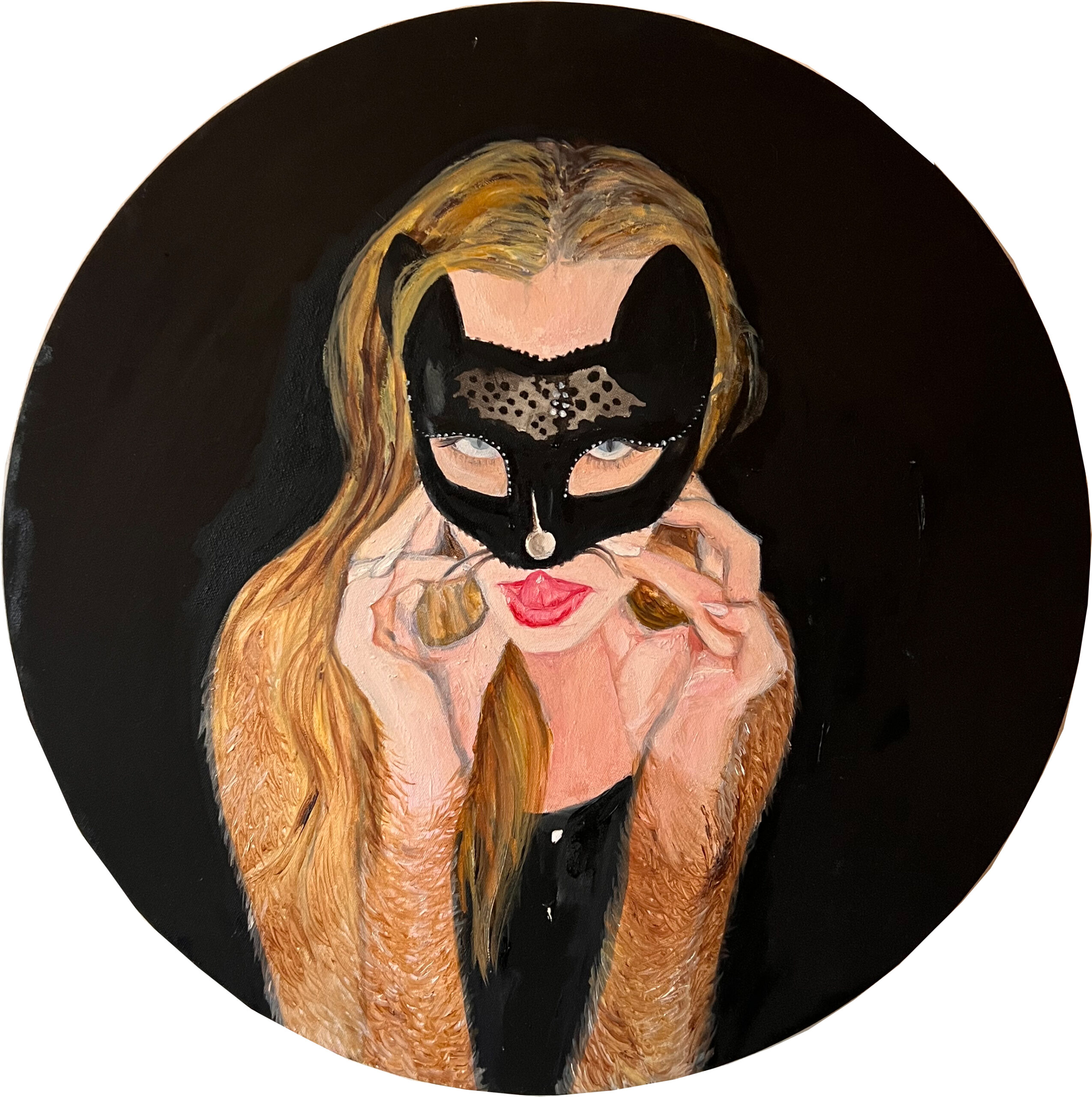
My practice investigates how bodies become borders and how images participate in regimes of belief.
Raised in post-socialist Poland and working within Nordic public cultural governance, I operate between different political imaginaries of Europe. This position informs my work with painting, installation, and curatorial formats as interrelated tools for examining how ideology circulates — not abstractly, but through flesh, institutions, and aesthetic traditions.
In my paintings, I construct figures that inhabit the unstable terrain between realism and myth. Marian iconography, neoclassical eroticism, and devotional aesthetics function not as illustrations of faith but as technologies of discipline. I am interested in how the female body — particularly the Eastern European body — has been shaped as a site of projection: pure yet excessive, devout yet erotic, peripheral yet necessary. These figures are not portraits; they are operational diagrams of how Europe manufactures its internal borders.
The figure of the Virgin — obedient, luminous, self-sacrificing — persists as a stabilizing structure within nationalist and neoliberal transitions. After 1989, the post-socialist female body entered Western circuits as adaptable labor, affective surplus, and eroticized availability. Inclusion and marginalization operate simultaneously. The Eastern European body is geographically “inside” Europe yet symbolically positioned as its intimate outside — emotionally excessive, culturally insufficient, permanently transitional.
Painting, for me, is not a nostalgic medium but a device for slowing down inherited visual orders. Through compositional hierarchy, exposure, ornament, and fracture, I test how beauty stabilizes power and how myth naturalizes inequality. Increasingly, I displace these works into expanded environments that incorporate archival materials, institutional language, and collective reading structures. This shift reflects my understanding of art as a field of assembly rather than isolated production — a space where the distribution of visibility can be renegotiated.
My curatorial and pedagogical practice extends this inquiry. Working in a rural public institution under intensified accountability structures, I confront how cultural governance regulates artistic autonomy through evaluation metrics and administrative transparency. These experiences sharpen my interest in para-institutional strategies: temporary formations that operate within systems while subtly misaligning their logic.